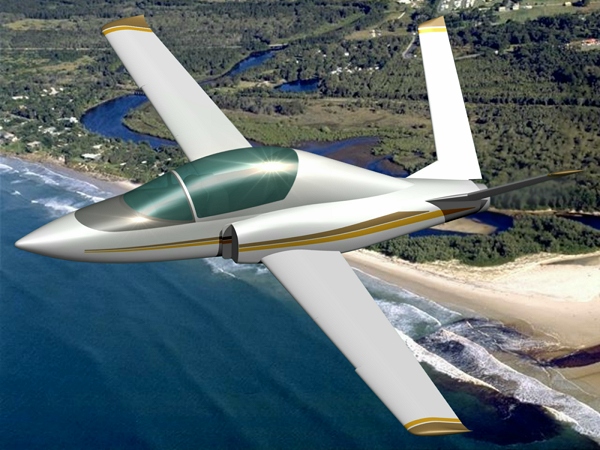
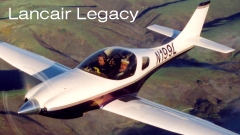
As homebuilt aircraft get more and more complex with aircraft like the Lancair IV and Legacy and even turboprop aircraft, it's natural that jets would enter the fold. One of the first to do so is the ViperJet. However with the engines that are currently utilized, aircraft like the ViperJet are larger and heavier than necessary. This is because these engines are more powerful and thirstier than what would be ideal for an airplane intended to efficiently move two people from one place to another. The resulting airplane has to carry a lot of additional fuel along with the extra weight of this oversize engine. In addition, because the engine is a fifty year old design, it is very noisy. The extra weight effects the landing speed and combined with the noise issue, its utility is limited because the number of airports it can use is reduced. It is true that these older engines cost far less than the new TurboFan engines. One can buy a lot of fuel for the extra $100,000 or so one would pay for a TurboFan. Even so, with an older cheaper engine, the resulting airplane simply cannot have the same capabilities.
 Wouldn’t it be great if there
was a personal jet in the same category as, say, a Lancair Legacy or Glasair III. A jet that could
takeoff and land on relatively short paved runways. A jet that carried you and a companion in pressurized
comfort at 25,000 feet and do it at a speed of 350 kts (403 mph)! A jet that is as easy to fly as a Mooney
or Bonanza, can carry enough fuel to travel over 1,000 miles, is very quiet and cost less to operate than a
new Beechcraft Baron!
Wouldn’t it be great if there
was a personal jet in the same category as, say, a Lancair Legacy or Glasair III. A jet that could
takeoff and land on relatively short paved runways. A jet that carried you and a companion in pressurized
comfort at 25,000 feet and do it at a speed of 350 kts (403 mph)! A jet that is as easy to fly as a Mooney
or Bonanza, can carry enough fuel to travel over 1,000 miles, is very quiet and cost less to operate than a
new Beechcraft Baron!
 That is exactly what the
HawkJET™
is designed to be! With a maximum takeoff weight of 2,800 pounds, a 32.5 foot wing span, a single Williams
FJ44 TurboFan engine and the awesome appearance of a miniature fighter jet, the
HawkJET™
is truly a unique aircraft!
That is exactly what the
HawkJET™
is designed to be! With a maximum takeoff weight of 2,800 pounds, a 32.5 foot wing span, a single Williams
FJ44 TurboFan engine and the awesome appearance of a miniature fighter jet, the
HawkJET™
is truly a unique aircraft!
The HawkJET™ has a roomy cabin with tandem seating like a military fighter jet. There is ample room for two adults over six feet tall. The rear seat is also elevated relative to the front seat to allow greater visibility for the aft seated crew member. The HawkJET™ utilizes true fowler flaps that contribute to its 61 knot stall speed, enabling it to use airports that no other jet can. In addidition to the obvious added utility, this low stall speed is a huge safety feature which is unheard of for any jet.
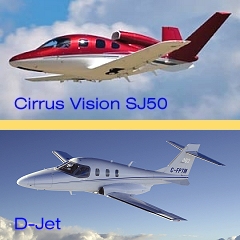
This is the dawn of a new era in general aviation. There are a number of new designs entering the market for "Very Light Jet" (VLJ) aircraft. Pratt & Whitney and Williams International are developing state-of-the-art powerplants for this new class of jet aircraft. Diamond Aircraft is flight testing the D-Jet and Cirrus Designs has now flown their CJ50, Vision "Personal Jet". A Personal Jet is distinguished from a VLJ in that a VLJ is still essentially a corporate jet – only smaller. On the other hand, a Personal Jet is a privately owned airplane (like a Mooney or Bonanza) that happens to be a jet. It has different capabilities and performance because it has a different mission. Both Diamond Aircraft’s D-Jet and Cirrus Designs' Vision are two of these, as is the HawkJET™.
We are now at the cutting edge, creating the future of personal transportation and the HawkJET™ is an exciting part of that future.
The HawkJET™ is a thrilling mix of proven technology, creative engineering and elegant design. Although it is a "complex" airplane, its systems are designed to be simple and straightforward and the reliability of a modern turbine engine will minimize maintenance costs. It promises to be a fun, fast and efficient traveling machine that will turn heads wherever it goes.


